
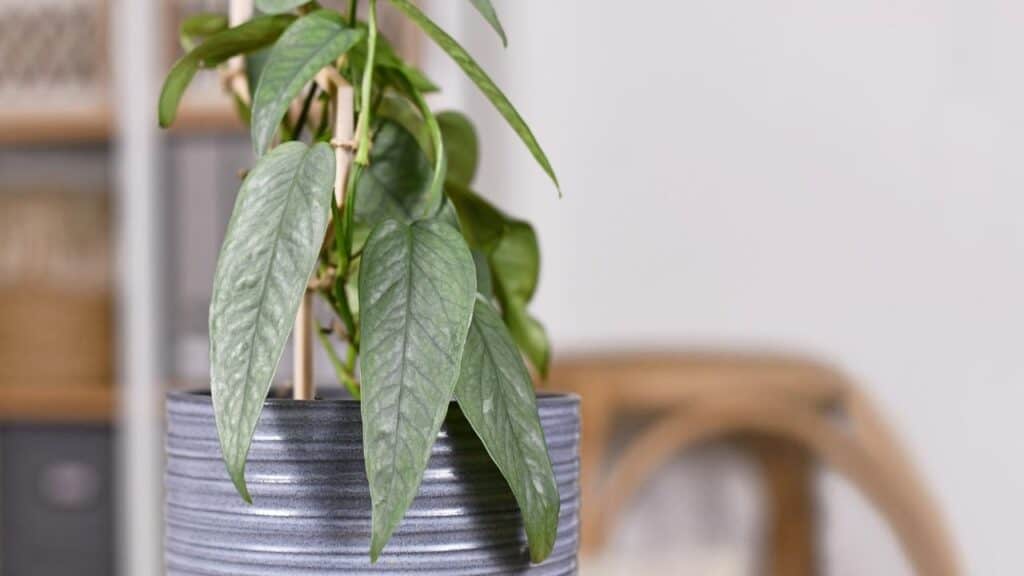
Pothos plants are one of the most popular houseplants around, and for good reason – they’re easy to care for and can thrive in a variety of conditions. If you’re looking for a low-maintenance plant to add to your home, the Cebu Blue Pothos is a great option.
In this guide, we’ll walk you through how to care for Cebu Blue Pothos plants so they stay healthy and beautiful.
About the Cebu Blue Pothos
The Cebu Blue Pothos is another stunning and Instagramable plant that is easy to keep. Its silvery bluish green foliage makes it a very unique and sought-after plant. It’s a plant that belongs to the Epipremnum genus.
Cebu Blue got its name from Cebu island in the Philippines, where it originated. It is toxic to pets like cats and dogs, so it should be placed above their reach.
Origin
The Epipremnum pinnatum Cebu Blue of the Araceae family is native to Cebu Island in the Philippines. It is also called blue pothos because of its silvery blue-green leaves.
Characteristics
The Cebu Blue is an evergreen vine that grows up to 40 feet long outdoors and around 8 feet long indoors. It thrives best in partial sun exposure in moist but well-draining soil. It can grow on acidic, neutral, or alkaline soil pH.

Growing Instructions
Growing the Cebu Blue is relatively easy, just like other pothos. It can grow indoors and outdoors as well. There are two growth phases of Cebu Blue – juvenile and mature. The young Cebu Blue has small silvery blue-green elongated oval leaves.
On the other hand, the mature Cebu Blue has large green leaves with fenestrations. These usually grow large outdoors. Top cuts of these mature Cebu Blue can be grown indoors.
Light
The Cebu Blue pothos grow best in medium bright indirect light. It will not do well in low light for long periods, like the golden pothos or jade pothos. It will also not do well under direct sunlight, which will burn its leaves.
Place it near a window with thin curtains that will provide it with medium bright and indirect light.
Water
The Cebu Blue pothos will be damaged by overwatering. To determine when to water, feel the top few inches of the soil is dry, and then it’s time to water the plant. Hold it over the sink until the water runs out of the drainage hole, and put back the pot in a saucer.
Regular watering will benefit Cebu Blue during its growing season. Cut back on watering during the winter when the plant will be dormant.
Soil
Moist but well-draining soil is ideal for growing the Cebu Blue pothos. You may achieve this by mixing potting soil with one part perlite and one part orchid bark. Be sure that the pot used also has enough drainage holes.
Fertilizer
Applying a balanced liquid fertilizer to your Cebu Blue pothos once a month during the spring and summer will aid the plant in the growing season. The plant’s dormancy starts in autumn, so stop applying fertilizer until wintertime.
Temperature and Humidity
The Cebu Blue pothos is native to a tropical climate in the Philippines, but it grows well indoors, too. Providing extra moisture to the Cebu Blue pothos will help them grow robust and fast and help produce larger leaves.
To achieve this, place a humidifier near the plant to place the plant in moisture-rich areas in the house like the kitchen, laundry room, and bathroom. When the temperature drops to freezing, keep it in a warm area, away from the window where chilly winds can damage it.
Toxicity
Epipremnum is toxic to cats and dogs, so make sure to put the Cebu Blue pothos away from pets. If ingested by cats or dogs, consult your vet.
Potting and Repotting
The Cebu Blue pothos need well-draining pots. Use small pots, and when repotting is needed because the plant is root bound, choose a pot just slightly larger than the last pot.
The Cebu Blue pothos is a trailing vine; the young Cebu Blue pothos can be grown in hanging planters. The mature plants, on the other hand, need a pole or trellis to thrive.

How to Propagate
Cebu Blue pothos are easily propagated through cuttings. While pruning the Cebu Blue photos can make the plant lush and encourage fuller growth, it would also be a time to repurpose the stem cuttings from pruning to propagate the plant.
The stem cuttings can be rooted in water and sphagnum moss. To root in water, first, take stem cuttings from the Cebu blue pothos using a pair of shears or scissors or a cutter. There should be at least 5 or 6 leaves on the stem cutting. Next, expose the nodes by removing the lower 2 or 3 leaves.
Submerge the exposed nodes and water but leave the remaining leaves above water. Replace the water every two or three weeks and wait for roots to grow to at least one or two inches before transferring to a small pot with moistened, well-draining potting mix.
Place the potted plant in an area that receives medium to bright indirect light. Keep the pot moist for around two weeks to help the roots acclimate, then water regularly after the top inch of soil mix is dry.
When using sphagnum moss, first soak the moss in the water while you snip the stem cutting with 5 to 6 leaves. Expose the nodes by removing 2 or 3 leaves and draining the water from the moss. Put the moist moss in a clear container and put the cutting in. Make sure that the moss covers the exposed nodes.
Cover the plastic container with a resealable plastic bag to increase humidity but make sure the leaves of the cutting are outside the bag. Keep the moisture even by misting the moss every week.
The roots will grow about after three weeks. Use a clear container so you can see if the roots are growing. When roots are about 1 to 2 inches long, you may transfer them to a soil mix. Choose a small pot with a well-draining potting mix.
Moisten it and transfer the plant to it. Place the potted plant in an area that receives medium to bright indirect light. Keep the pot moist for around two weeks to help the roots acclimate, then water regularly after the top inch of soil mix is dry.
Common Pests and Plant Diseases
The Cebu Blue pothos can be attacked by mealy bugs and scales. These are sap-sucking pests that destroy leaves. An indication of their infestation is a sticky residue on the stems and leaves of a plant. Applying a pesticide will help eradicate the problem.
Another pest of the Cebu Blue pothos is fungus gnats coming from the moist soil. Applying a quality fungicide will help solve the problem.

Common Problems
Common problems of the Cebu Blue pothos are yellowing leaves and wilting or curled leaves.
Yellowing leaves can result from overwatering, sunburn, underwatering, and lack of humidity. To avoid these problems, observe regular watering when the top 2 inches of soil is dry, place the plant in medium to bright indirect light, and keep a humidifier nearby or place it in moisture-rich areas like the kitchen, laundry room, and bathroom.
Wilting or curled leaves are a sign of underwatering. If, after watering for some time, the leaves don’t perk up, the roots may have dried out. Remedy this by cutting the stems and propagating.
Slow growth may also be a problem caused by a lack of light. Try moving it to a brighter area but away from direct sun. Check on watering also. It may be underwatered.

