
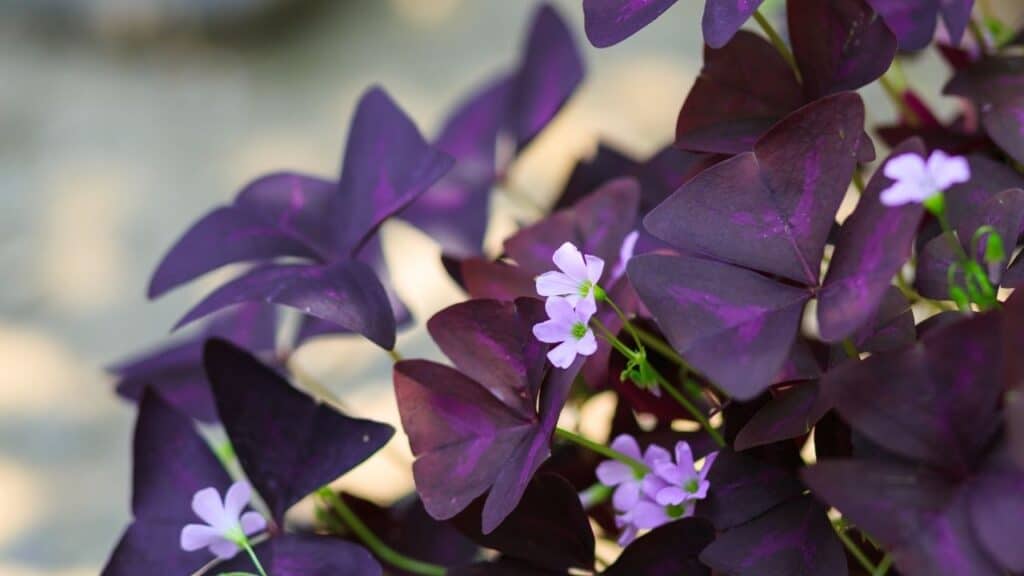
Let us talk about an intriguing plant that can be used as a gift or decorate a home named Oxalis triangularis.
It’s a bulbous blooming plant from the oxalis genus called purple shamrock or wood sorrel.
Have you ever heard about some of these features, “Photophilic” or “heirloom plants”?
Oxalis triangularis is very “photophilic,”. This means it responds to light by opening and closing both its blossoms and leaves.
Oxalis triangularis is a long-lived plant passed down through families as “heirloom plants.”
Did you also know that we can eat blossoms?
About Oxalis Triangularis
Special Traits
Oxalis triangularis resembles a cluster of little purple butterflies. It opens broadly in the morning light. The brilliant purple color of its leaves, as well as the prolonged sluggish motion, appear to charm those who see it.
Flowering
Oxalis triangularis flowers are lovely purple foliage. Flowers are pale pinkish-purple and white. The blossoms, like the leaves, seal up at night.
Dormancy Period
Oxalis triangularis goes lifeless if the growing season is over.
The plant might appear wilting, and the leaf may stop opening.
When it has died back, you can remove the dead leaves.
Transfer the pot to a darker or cooler spot for at least a month, but it may take longer.
It is not to be fed or sprayed.
As soon as new growth appears, begin the regular maintenance regimen for this plant.
Water it softly at first, then gradually increase the amount of you give until it reaches its regular level

Oxalis Triangularis Plant Care (Growing Instructions)
Light
Oxalis triangularis prefers direct light that is bright to medium. This does not have to come from the sun.
For the first several days, keep an eye on your plant under the grow lights. If necessary, adjust the distance between the plant and the light.
Water
When the top inch of the potting mix is dry, water your Oxalis. If left too dry for too long, it may start to become dormant, but don’t overwater it, or you risk root rot.
Temperature
O. triangularis requires a cold indoor temperature of 15 °C (59 °F) and indirect solid sunlight. It can withstand greater indoor temperatures for short periods. However, if temperatures exceed 27 °C (81 °F) for lengthy periods, it will begin to look “weary.”
Humidity
Normal household temperatures are suitable. It is better to try keeping it between 60 and 75 degrees Fahrenheit (15.5 and 23.8 degrees Celsius).
Soil
- Soil contents must have these.
- pH of the soil: Acid (6.0) o Acid (6.0) o Acid (6.0) o Acid
- High alkalinity (>8.0)
- Undecided (6.0-8.0)
Drainage of the soil:
- Ample Drainage
- Soft and moist
- Dry on occasion
Fertilizer
You can use a half-strength mixed liquid potted plant fertilizer every week or so while the plant is not dormant.
Repotting
Repot your Oxalis triangularis every other year. To give the plant room to expand, use a pot that is one size larger than its current pot, and make sure the pot has adequate drainage.
In a container, plant the bulbs one to two inches deep in the damp potting mix, especially when the plant is dormant. So they don’t wind up on top of each other; make sure they’re at least an inch apart.
After giving them some water, return them to bright and indirect light. As soon as the dormancy time is through, try to accomplish this. Do not attempt this immediately after the plant has gone dormant; it will require time to recover. Be patient since growth can take several weeks.
Potting Compost
Use a moisture-retaining, well-draining potting mix.
A perlite-supplemented indoor plant potting mix can be used.
You can also add peat, which will help to retain moisture.
Toxicity
The taste of the oxalis plant deters cats and dogs from eating it. It contains oxalic acid and oxalate ions.
When the plant is ingested and absorbed by the gastrointestinal system, oxalate salts bond with calcium in the body, causing a decline in calcium, it might also cause abrupt renal failure, drooling, inappetence, vomiting, lethargy, diarrhea, weakness, tremors, blood in urine, thirst, and urination. These are some of the clinical poisoning indications.

How to Propagate
Oxalis Triangularis Propagation by Bulbs
• While the plant is dormant, you may quickly reproduce your Oxalis triangularis by repotting the bulbs into different pots. This is accomplished in the same manner as in the repotting section:
• Place the bulbs one inch to two inches deep in wet potting mix in a pot. Make sure they’re at least an inch apart, so they don’t end up on top of each other. Put them in bright, indirect light with a little water. Try to do this as close to the conclusion of its dormancy as possible. Don’t do this just after the plant becomes dormant; it needs time to rest. New growth may take a few weeks to appear.
Oxalis Triangularis Propagation by Division
• While your plant is out of dormancy, you can divide it. If your plant is lovely and packed, you can divide it into two, three, four, or more portions, each with its bulbs.
• Gently take the plant from the pot and detach a piece. Be careful not to harm the roots and ensure that the entire root cluster and its bulbs are included with the plant. If the roots are knotted, cut them away with clean, sharp scissors. Try to keep as much of the root as possible intact.
• Repot each piece into its appropriate-sized pot, then water it thoroughly. Place it in bright, indirect light. Some foliage on your plant may close up due to the shock. Allow some time for it to adjust.
Common Problems
White spots
Powdery mildew (a fungal illness) is a common cause of excessive moisture caused by damp, dark, humid circumstances with poor air circulation. The condition is usually minor and will go away on its own. If this is severe, you can use a fungicide to cure it. If you have pets, be sure to follow the label’s recommendations and proceed with caution.
Pests
Aphids, spider mites, and whiteflies are all potential pests. Many plant lovers prefer Bonide Systemic Houseplant Insect Control for overall houseplant pest control. Make sure to follow the label’s recommendations and proceed with caution to save pets.
Botrytis produces spores, which appear as greyish “mold” patches. Because this fungus can swiftly spread to other plants, use a copper-based fungicide to control it. Biological fungicides are also effective.
Rust is a fungus that causes leaves to turn yellow. Eventually, the leaves produce reddish, rusty-looking spore spots. While this is most prevalent when your plant is preparing to go dormant, it can happen at any time of year. To get rid of it, use a fungicidal spray.

Conclusion
Allow me to give you some more botanical knowledge.
Another name for this plant is False Shamrock Plant. The leaves are shaped like shamrocks. As the sun rises, these leaves open wide, capturing the sun’s rays. In the evening, they can be folded up like an umbrella.
The history of the plant can be traced back to St. Patrick. The Royal Horticultural Society’s Award of Garden Merit was given to this wonderful plant.

