
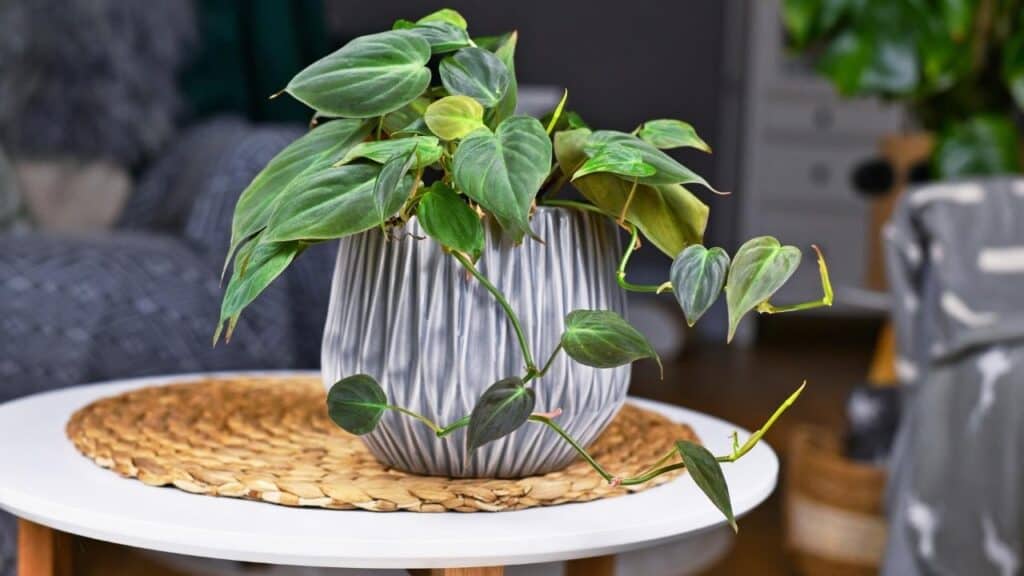
Plants, like people, are attractive. Aren’t appealing species like magnetic materials that can draw photographers in? The Philodendron Micans is an Instagram-worthy organism from the domain Plantae.
This kind of Philodendron hederaceum is also known as Philodendron hederaceum var. hederaceum, and is prized by “plant aficionados” for their rapid development.
It’s a magnificent sight to see them shift from an emerald green with pink edges to a velvety, iridescent deep green with a deep purple-red tint.
Bear with me! I’ll show you how to cultivate Philodendron Micans in its entirety.
About Philodendron Micans
This Philodendron’s long velvety-textured, heart-shaped leaves and rusty scarlet overtones make it so beautiful. You’ll find yourself peering into its velvety abyss.
This is a gift hailing from Central America and the Caribbean.
It will be a fast grower if good care practices are applied. These trails and climbs. From a 6-ish foot tall shelving unit, a heart-leaf philodendron reaches down to the floor.

Plant Care (Growing Instructions)
Light
These plants need brilliant indirect light. If you have a southern-facing window, use a sheer curtain or keep the plant farther away from the window. It may grow stemmy or leggy when the plant isn’t exposed to bright indirect light.
Water
When the top several inches of the potting material is dry, water them. Don’t let them sit in water, as this will cause root rot. Ensure they’re well-watered to drain water away from the drainage holes. Make sure to water less frequently throughout the colder months. Let the potting dry completely before watering again.
Temperature
Philodendron Micans is a tropical plant, so keep it warm. The recommended temperature range is 65 to 80 degrees Fahrenheit.
It’s also tolerant of a wide range of household temperatures.
Humidity
Micans philodendron grows well in moist environments. When high humidity levels are provided, the leaves will grow larger and healthier.
You can use a spray bottle to mist the leaves or place the plant pot on a tray with stones and water. To raise the humidity surrounding any plant, you can use humidifiers.
Soil
Philodendron Micans appreciate nutrient-rich, moist, and well-draining soil. When repotting your plant, use a pot that is the proper size for it. Replace the plant in a pot 2-3 inches larger than the one it was in before. Repot your plant near the end of the winter/beginning of the spring before they begin to grow again aggressively.
Fertilizer
Please give them a light dose of a rounded 20-20-20 fertilizer during their growing season. Fertilize only in the spring and summer. If your soil is fresh and contains fertilizer additions, you may not require more fertilizer.
Repotting
Make sure the pot isn’t too big for the root ball when repotting yours, as this can cause the roots to become too damp. You can have your own with a mixture of worm castings, orchid bark, perlite, horticultural charcoal, and sphagnum moss.
Pruning
Cutting the stems can help give the plant a fuller appearance. Because chopping the ends off of branches fosters new development from the side of the stem just above the cut, new growth is encouraged. If the plant is not pruned, the single strands will continue to grow without branching.
Climbing and Support
Philodendron Micans climbs via aerial roots in its natural habitat. Aerial roots also assist in absorbing nutrients; therefore, using them will only benefit your plant. Philodendron Micans climbs via aerial roots in its natural habitat. Aerial roots also assist in absorbing nutrients; therefore, using them will only benefit your plant.
You can use wood, wire, rattan, and bamboo. A trellis, spindle, and even spherical arches can also be used.
You can always make your own with a bit of wire coated in plastic or non-rusting wire if you’re talented enough.
Whatever method you choose, make sure the climbing plant supports are inserted into the container when planting.
You can use wood, wire, rattan, and bamboo. A trellis, spindle, and even spherical arches can also be used.
You can always make your own with a bit of wire coated in plastic or non-rusting wire if you’re talented enough.
Whatever method you choose, make sure the climbing plant supports are inserted into the container when planting.
Toxicity
Cats and dogs are poisoned by Philodendron Micans, therefore keep it away from them. They include calcium oxalate crystals and are classified as a Level One toxin. It’s not a good idea to chew on the leaves of plants.

How to Propagate
How to Propagate Philodendron Micans in Water
1. Cut about a 1/4 inch below a node on a portion of the vine with a few leaves with a clean pair of clean scissors. Include the node because that is where new roots will emerge.
2. Submerge at least one node of the cutting in a jar filled with room-temperature water.
How to Propagate Philodendron Micans in Soil
Method One
- Cut roughly a quarter-inch below a node on a piece of the vine with a few leaves with a clean pair of scissors. Because new roots will develop from the node, you must include them on the cutting.
- In a suitable-sized pot, plant it directly into a wet potting mix. Make sure that at least one node is covered in a thick potting mix, as this is where the roots will develop, and none of the leaves are buried.
- Keep the potting mix moist but not wet, and place the cutting in a bright, indirect light source.
- You may also cover the top with a clear plastic bag to help seal in humidity, but make sure to open it every few days to let fresh air in.
- It will take a few weeks for a new root system to form and noticeable new growth to appear on the cutting.
- You may also give your plant a mild tug after a few weeks to see how it responds. If the plant has formed a root system, it can be treated as a typical plant.
Method Two
- With vining plants like Philodendron Micans, another simple way is to put the entire cutting down on top of the potting mix’s surface, with all of the vine’s nodes pointing down into the mix.
- Use bobby pins or paper clips to temporarily “fasten” the vine to the mix if necessary. Place the mix in bright, indirect light and keep it moist but not damp.
- You may also cover the top with a clear plastic bag to help seal in humidity, but make sure to open it every few days to let fresh air in.
- The nodes will eventually take hold in this manner as well!
- Position the cutting in a bright, indirect light source. When the water level drops, top it up and change it every few days to a week if it becomes murky or slimy.
- Roots will emerge from the nodes within a few days, but you’ll have to wait a few weeks to put your cutting in a potting mix.
- Wait until the roots have grown to a length of two to three inches. After that, transmit the data.
- Transplant it to a permanent pot, water it well, and care for it as you would any other plant.
Common Problems
Pest infestations
Plants of the genus Philodendron micans are sensitive to a range of common houseplant pests. These can be mealybugs and aphids. To eliminate this, you can use cold water to rinse the leaves.
Secondly, clean the plant’s remaining leaves using a dish soap and water solution that does not contain a degreaser. Finally, wipe down or spray your plants with a neem oil solution.
Yellowing or limp leaves
Overexposure to direct light can cause the leaves to burn, resulting in a yellowing look. Too little light can also result in yellowing foliage. Limp leaves might indicate a lack of or excess of water. Alter your lighting and watering habits to meet the plant’s needs.
Brown leaves
A lack of humidity in the air might cause the leaves to dry up, resulting in brown margins or tips.
Browning can also be caused by a burn from too much direct light. Make the necessary adjustments to the lighting. And, while we’re on the subject of burning, over-fertilizing might cause the leaves to burn. Remember that more fertilizer doesn’t always equal a better plant; always fertilize according to the package directions.
Leggy Vines
When a plant does not receive enough light, this happens. It isn’t a major concern, but it can be unappealing visually.
With fewer leaves, the vines grow long and stretched out so expose it to bright, indirect light.
Conclusion
The simple line is that this is the best low-maintenance plant we’ve ever seen. This is deserving of a lot of attention.
If you have a tiny space, Philodendron Micans is ideal. They can be placed on a shelf or the floor, but be aware that the trailing pieces will outgrow the pot.
The only disadvantage is that it is toxic, so children and pets should be kept away from it.
If I were you, I’d ask your kindest buddy for a cutting and go online to get it.
This fascinating plant has caught my curiosity. In that case, I’d like to express my admiration through my article. I hope you had fun.

