
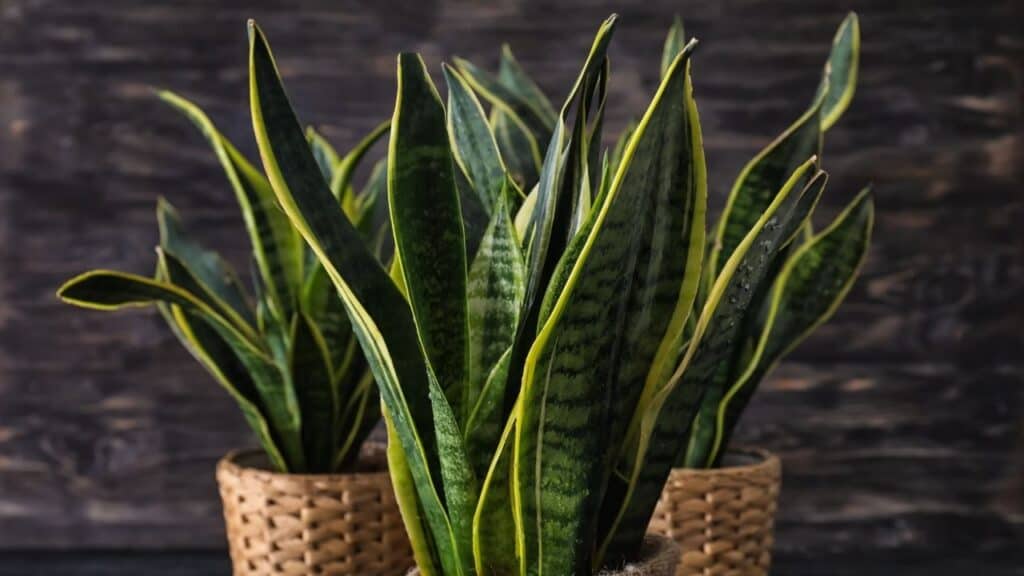
Sansevieria plants have a robust air-purifying ability. These are included in a chart of air-filtering plants.
Apart from being used as air purifiers, they are also used as indoor plants.
Feng-Shui experts consider this plant to bring good fortune. The plants emit positive chi energy. These are best placed in the house or office’s southern and eastern corners. They defend the area by combating negative energy. (Tanya Sood, September 2019)
The snake plants are stunning specimens. These plants are perfect for adding a fashionable touch to your apartment or house.
Finally, they’re very hardy and don’t suffer many bug problems. The most excellent part is that they don’t need to be watered for up to three weeks.

10 Types of Sansevieria
1. Sansevieria trifasciata
Sansevieria trifasciata leaves are deep green, while others are variegated or even curly. These are typically three feet long and 2.5 inches wide when mature.
It prefers moderately bright light but can also survive in low-light conditions. It prefers well-drained soil because excessive moisture can cause root rot.
It comes in various varieties such as Nelsoni, Midnight Shine, Moonshine, Hahni, etc.
2. Sansevieria francisii
Sansevieria Francisii is a low-maintenance air purifier houseplant that is hardy and drought-tolerant. Leaf cuttings and runners can be used to propagate these plants.
This plant has densely packed rows of leaves on its stem. Stolons are formed from the stem of the leaf base when the stem is fully stacked.
Leaves grow in the distinct rows on a stem that is tightly arranged in a spiral shape. They are short, round, and have brownish-red and white pointed tips. The green foliage has greenish-gray horizontal wavy stripes. Each leaf has one shallow channel and 4-6 dark green vertical lines.
3. Sansevieria hyacinthoid
Sansevieria Hyacinthoides is a drought-tolerant, fast-growing plant. It grows quickly and requires little care, making it ideal for large gardens. The leaves are vibrant in color.
It grows best in warm or partial shade, in any soil type with compost added. Use a small amount of water.
It can be propagated through seeds, cuttings, or large bunch separation.
4. Sansevieria gracilis
One of the smaller Snake Plant kinds is this one. It has a beautiful, sweet-smelling blossom.
The leaves are usually kept to a height of around 18 inches. It has clusters of greenish-white flowers that bloom in the late fall.
Sansevieria gracilis thrives in filtered bright light or partial sun. This plant can thrive in full shade or low light. However, the colors will not be as brilliant as they would be if they received more sunlight.
Propagation is achievable through leaf cuttings and offsets, as with most Sansevieria variants.
5. Sansevieria canaliculate
Sansevieria canaliculata (Snake Plant) is a stemless perennial succulent. This grows from underground rhizomes and has cylindrical leaves.
The plant’s cylindrical leaves can grow up to three feet long and an inch wide at maturity. Leaves can grow in pairs or singly.
This plant prefers bright, filtered light and soil that drains well. This plant will thrive with infrequent watering.
6. Sansevieria patens
This rosette-shaped Sansevieria has short, cylindrical leaves. The grooved leaves can grow to be three feet long and two inches wide.
Dark green with light green bands is the most common color combination. The plant produces clusters of grayish-white blooms while it is in bloom.
7. Sansevieria trifasciata ‘Laurentii’
The leaves of this Sansevieria cultivar are deep green with golden borders. The plant can grow up to four feet tall when fully mature.
The sword-shaped leaves, like those of other Sansevieria species, grow vertically in a close clump. This cultivar blooms infrequently, but when it does, it creates a short inflorescence with greenish-white leaves at the top.
Laurentii thrives in brighter light which produces more vibrantly colored leaves. This plant prefers to be watered seldom, especially in the winter. Root rot can be avoided by using soil that drains well.
8. Sansevieria cylindrical
These aren’t all that common. The upright, columnar leaves can reach a length of a meter and a thickness of 2 to 3 centimeters.
They range in color from green to grayish. Dark green transverse bands are seen on young plants. With time, the leaves get a little furrowed.
Braiding the leaves when they are still young and fastening them at the top is a popular method—this aids in the management of growth as well as the creation of an appealing arrangement.
9. Sansevieria fischeri
Sansevieria fischeri is one of the lesser snake plant kinds, reaching a mature height of fewer than 16 inches.
It’s an excellent plant for container gardening, but it also thrives outdoors. The plant develops an inflorescence with tubular white blooms in the summer.
This Snake Plant species thrive in areas with plenty of sunlight and good drainage. Because it is not a frost-tolerant plant, bring it inside or cover it if the temperature drops below freezing.
10. Sansevieria masoniana
Bright light is ideal for Sansevieria masoniana. If this plant does not receive enough sunlight, it is unlikely to bloom.
It only needs water when the soil is completely dry, and it should never be left in standing water.
This Snake Plant is also referred to as Whale’s Fin or Shark’s Fin. It has broad, mottled green leaves that are four feet long.
The paddle-shaped leaves may be varied depending on the species. This plant’s purplish sheath makes it easy to identify, but it’s usually hidden beneath the soil line.

How to Care for Your Sansevieria
Light
Sansevierias are versatile plants. It enjoys indirect light that is medium to bright, although it can also take lesser light and direct sunlight. If possible, choose a location that receives both direct and indirect sunlight.
Water
Overwatering is the most prevalent succulent plant problem that farmers confront all over the world. Therefore, don’t leave the soil moist for lengthy periods, especially during the winter.
It’s best to water your plant from the bottom up.
When the soil is entirely dry, fill the pot halfway with water. Then, drain any water that has gathered in the saucer through the drainage hole at the bottom.
Temperature
Sansevieria flourishes in temperatures from 55 to 85 degrees Fahrenheit. They prefer higher temperatures.
These can grow in various environments as long as the temperature does not drop below 50 degrees Fahrenheit (10 degrees Celsius). If you end up leaving your plant outside during the cold, it will dissolve quickly.
Humidity
Sansevieria can withstand substantially lower humidity levels than 40%. Even in dry winters, they don’t require any additional humidity. As a result, make sure the leaves are dry at all times.
Soil
The majority of Sansevieria plants thrive in well-draining, sandy soil. A 3:1 ratio of loam and pumice is recommended. Succulents can also be grown in potting soil.
Fertilizer
Throughout busy development months of spring and summer, fertilize with a fluid or water-soluble compost once a month.
Sansevieria does well at pH levels ranging from 4.5 to 8.5, but a pH range of 5.5 to 7.5 is advisable. The pH range for total production in limerock soils is typically 7.5 to 8.5.
The pH of beds formed in sandy soils supplemented with peat or potting mixes should be corrected with sedimentary rocks to a range of 6.0 to 6.8. Dolomitic limestone contains sufficient amounts of calcium.
Repotting
Sansevieria rarely needs to be repotted. Potting is likely only required when the plant’s roots cause harm to the existing container.
Make careful to use loose, well-draining soil when transplanting it to a new pot. Rich soils will retain more moisture, which is undesirable for most houseplants.
Only repot the plant in the spring when it becomes overcrowded and has to be divided.
Common Issues
According to the “American Society for the Prevention of Animal Cruelty,” Sansevierias contains a poisonous substance called Saponin, which can induce painful reactions in animals.
On the other hand, there are no severe pest or disease issues. Bugs, spiders, and mealybugs should all be avoided.

Conclusion
I am glad to mention that as a grower of Sansevieria trifasciata, I have received excellent comments from my friends.
Having these plants around the house appears to be all the rage nowadays. My friends’ top goal is to clean their home’s air of pollutants, pathogens, and any filth that may have accumulated within.
This is a low-maintenance plant that may be grown by both beginners and professional gardeners.
If you’re the type of person who forgets to water their plants, this kind might be the plant for you. These are drought-resistant because they exchange oxygen and carbon dioxide during the night, preventing water from evaporating.

