
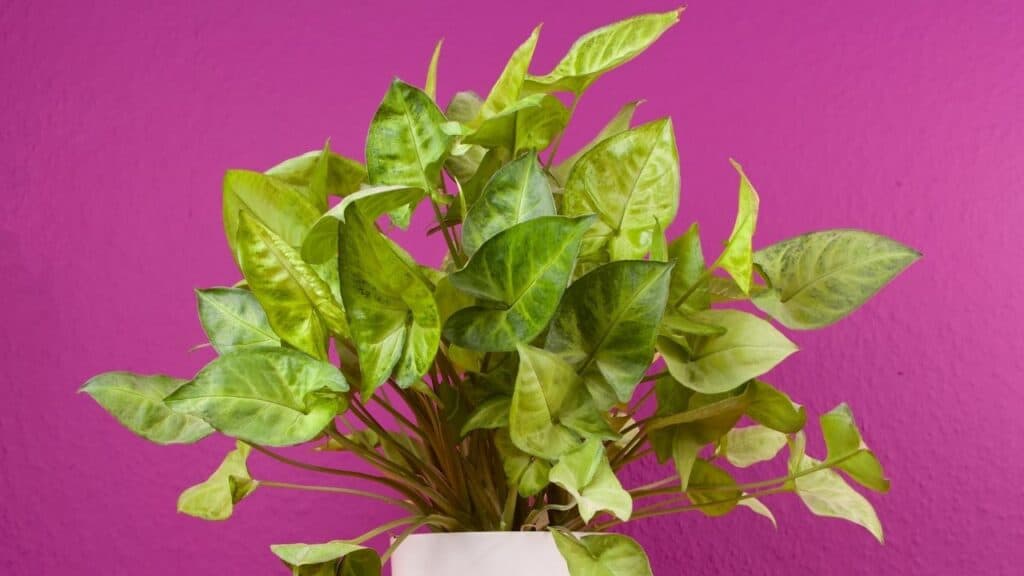
Syngonium stands for:
- S- emi- tropical plant
- Y – yes to elegance
- N – nice houseplant for homes
- G- Goosefoot
- O- outdoor plants
- N –numerous leaves
- I – inexpensive
- U-undemanding for care
- M – material comfort, and mental health provider
Different types of Syngonium vine provide interest to your decor. Some have magnificent variegated foliage flushed with white, cream, silver, pink, or purple.
Here’s how to raise Syngoniums from start to finish. It’s worth looking into.
Syngonium Varieties
1. Syngonium podophyllum
- aka “berry allusion”
- leaf color: light green
- shades: pink and cream
- qualities: low-light houseplant and easy to grow
2. Syngonium podophyllum
- aka “Bold Allusion”
- leaf color: creamy-green leaves and pink veins
- qualities: thick, large platter-shaped leaves
3. Syngonium podophyllum
- aka ‘Cream Allusion’
- leaf color:dark green leaves with silvery-white veins or a center surrounded by green
- qualities: has four to eleven flower spikes (spadixes) that form in the leaf axils and each contains 6–9 green tubular flowers
4. Syngonium podophyllum
Exotic Allusion nephthytis shows off light green leaves flushed with creamy white.
- aka ‘Exotic Allusion’
- leaf color: has light green, cream-colored leaves
- qualities: versatile houseplant with arrowhead-shaped, variegated leaves
5. Syngonium podophyllum
- aka ‘Holly
- leaf color: White leaves with green veins and edges.
- qualities: non-vining Syngonium
6. Julia Allusion Nephthytis
- aka Berry Allusion
- leaf color: leaves are light green with coppery pink highlights.
- qualities: Evergreen with a high tolerance for humidity
7. Syngonium podophyllum
- aka ‘Maria Allusion’
- leaf color: light green, heavily shaded, and infused with coppery pink
- qualities: Self-direction and compactness of habit
8. Syngonium podophyllum
- aka ‘Painted Arrow’
- leaf color:creamy-green leaves with light green splatter
- qualities: can coexist with other varieties
9. Syngonium podophyllum
- aka ‘Pink Allusion’
- leaf color: are primarily green to pink, with dark green margins
- qualities: pink veins accentuated
10. Syngonium ‘Strawberry Cream’
- aka’Strawberry Cream’
- leaf color: bright pink leaf color.
- qualities:exhibits distinctive pink new growth

Syngonium Plant Care (Growing Instructions)
Light
These plants are low-light tolerant. Growing them in medium to bright indirect light will help them grow quicker. This also improves rich coloration and markings. The leaves of these plants will be scorched if exposed to direct sunlight.
They despise being in the sun.
Water
During the summer months, keep the soil mix moist. During the cool weather, it must be drier.
Lower leaves will wither if they are overexposed to the sun, so be careful not to overdo it.
Container plants should be placed in a moist stone bed. Mist your hanging baskets regularly.
Temperature
Arrowhead Vines can thrive in temperatures ranging from 60 to 80 degrees Fahrenheit in most homes. They don’t like it when the temperature drops below 50°F. During the winter, keep them away from drafts and entrances.
Humidity
The average household humidity of 40-50 percent is sufficient for many indoor plants, but most houseplants benefit from humidity levels of over 60 percent if you can give it.
Soil
Use a thick potting mix with excellent drainage and aeration properties—plant in a pot with a drainage hole at all times. Root rot is caused by excess moisture in the soil.
Fertilizer
During the growing season, arrowhead vines should be fertilized once a month with 12 strength full liquid fert. In the early spring, use a slow-release fertilizer or a top dressing of worm castings or compost.
Several liquid plant fertilizers were evaluated for use as transplanting solutions a few years ago, and a 1-2-1 n-p-k ratio produced the highest yield (nitrogen phosphorus and potassium).
Repotting
In general, you should repot every other year and renew the potting soil in the spring; but, because these plants develop quickly, you may need to repot annually. Repotting regularly will result in even faster growth! Consider climbing a moss pole with them.

How to Propagate Syngonium Plants
Propagation of Syngonium is a breeze.
Water or potting compost can be used to root cuttings.
Both strategies are suitable as long as the plant is chopped in the right region.
To begin with, just below a node, clip the cuts to the required length. Double-check that the stalks are long enough to allow two or three nodes to touch the water or mixture.
Better make sure your cutters are clean and sharp before taking the cuttings. It is not an excellent way to make jagged cuts.
A few bottom leaves should be plucked from each stem. During the roots phase, they will most likely die, and new growth will emerge.
Place the cuttings in water or combine them. At least 2-3 nodes should be covered with water or the mix.

Common Pests & Diseases
Maintain a modest watering schedule and use the proper substrate to avoid the following problems:
- Plant root rot,
- Powdery Mildew,
- Blossom-end rot,
- Leaf infection
- Wilting
- Bacterial leaf spot
- Spider mite colonies
- Plant scale
- Aphids are also named Plant Lice, Plant Louse, Greenflies. Etc. Some gardeners use Organic Aphid Spray Made With Tomato Leaves and The Garlic Oil Spray.
- Sap sucking Mealybugs

Conclusion
To conjure up the essence of spring, several of my plant customers maintain syngoniums on their workstations.
Daybreak, freshness, and new ideas are all linked with spring.
They likewise assume that by putting them on the corners, something unique will happen. Anxiety, sleep problems, and quarrels will all be reduced.
These plants are well-liked by plant enthusiasts.

