
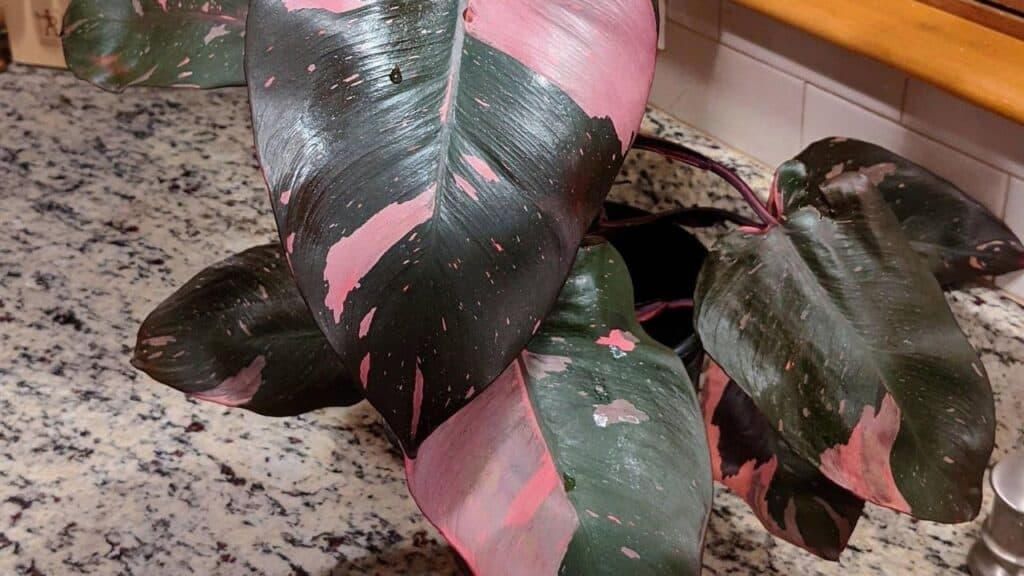
There is a lot of buzz about variegated everything right now, as you may have noticed on the internet.
Let me share a fun fact with you!
“Plants with variegation have patches of color on their leaves and stems that are different from the typical green.”
I want to highlight one of the variegated plants that are selling like hotcakes on the online market. Pink Princess Philodendron is the name of this plant.
I’ve done the legwork for you by including additional care instructions.
I also wrote do-it-yourself guides and a few secret methods here and there.
About Pink Princess Philodendron
One of the most sought-after collectible plants is the Pink Princess Philodendron. Gardeners love this plant because of its variegated heart-shaped bubble gum pink, green, and silver leaves. This plant is expensive because it is difficult to grow from seeds.
Origin
The Pink Princess Philodendron comes from Columbia in South America. It is a tropical aroid in the Araceae family. Being a tropical plant, it loves warm, bright indirect light.
Characteristics
The Pink Princess Philodendron has stable pink and green variegation, unlike the pink congo philodendron, which has been treated with chemicals to produce pink leaves and eventually revert after some weeks.

Pink Princess Philodendron Plant Care (Growing Instructions)
Light
The pink princess philodendron loves bright, indirect light. It should not be exposed to direct sunlight as it might scorch the leaves.
You can place the plants outside for 2 to 4 hours.
This Philodendron thrives inside and has a west or southeast-facing window.
Water
The Pink Princess differs from other plants in that it can live in water. Individuals kept in soil should be kept damp but not dripping wet.
Refresh your plant when at least 1-inch of the surface of the potting mix top is dry. Don’t let it become too dry, but also don’t let it get too wet. Root rot can be caused by overwatering your plant frequently.
Always examine the potting mix to determine if your plant needs watering.
Temperature
They are on cloud 9 when the temperature is between 75 and 84 degrees Fahrenheit (24-29 degrees Celsius).
Allowing the temperature to go below 60०F is not recommended (around 16०C). During the winter, remove the plant from drafty places and away from cold window sills.
Humidity
Given the correct amount of humidity, these plants produce lush and lustrous leaves. Gardeners note this.
This plant can survive in average houseplant humidity.
Temperatures between 60 and 95 degrees Fahrenheit (15 and 35 degrees Celsius) are ideal for the Pink Princess Philodendron.
Soil
Make a worm castings combination of 40% peat moss or coco coir. Add 30% orchid bark, 10% perlite (or pumice), and 10% worm castings.
Your plant will benefit from the moisture retention provided by the Peat Moss (or Coco Coir).
On the other side, orchid bark produces air pockets for your plant’s roots to breathe.
On the other hand, worm casting is high in organic matter and feeds your pink princess with nutrition. Perlite helps your mix drain excess water.
You can tweak this to suit your preferences.
Fertilizer
Once every month throughout the growing period, use a fluid potted plant fertilizer. Anyone wants to see this lovely plant reach its full growth potential. But avoid the temptation to fertilize it frequently. Overfertilizing your plant can cause severe damage and even death.
Repotting
Give your plant a pot large enough for roots to grow into if you want it to have the best chance of succeeding. Adding 2 inches of height and 2 inches of width is the most accessible approach to estimate pot size.
If your pink princess philodendron is still growing nicely in its pot, repot it every year or every two years. Also, repot it if you notice roots coming out of the drainage holes or if the roots are tightly curled around its soil inside the pot.
Flowering
The Pink Princess Philodendron also bears flowers, but the spathe is not as lovely as the heart-shaped variegated leaves.
How to Propagate the Pink Princess Philodendron
Water Propagation
1. Look for a node on the stem of your Philodendron pink princess.
2. A little reddish-pink lump appears as the node. Aerial roots are another name for these nodes.
3. Look for a stem section with more than one node for the most excellent outcomes. The odds of propagation are increased when there are 2-3 nodes.
4. Prune your plant, leaving at least a half-inch on both sides of each node.
5. Put the stem in a glass with enough water to cover the node by at least 2 inches, and you’re done!
Stem Cuttings
1. Choose a healthy, sturdy stem from your plant. On this stem, there must be at least two nodes.
2. Remove any leaves or connected leaves from the stem, leaving only the nodes.
3. On both sides leave at least 2 inches between the nodes.
5. Add the trimmed portion to a potting mix of only peat moss or a chunky blend of orchid bark and perlite.
6. Check that the stem is level with the ground (parallel to the soil). For the nodes to form roots, they must be lying down.
7. Make sure the pot you choose is suitable for the size of your cutting. It’s best to use a rectangle container with enough length to allow for chopping. Any appropriate pot will suffice.
8. Moisten your mixture evenly and cover it.

Common Problems
Brown Leaves
A Pink Lady’s leaves are expected to be dark green with a brilliant combination of pinks beneath them. Consider the quantity of humidity offered whenever you observe a brown color take over the edges or the entire leaf.
Adjusting the amount of misting provided to your Philodendron is one possible approach.
Yellow Leaves
Overwatering and over-exposure to direct sunlight are common reasons.
Solution: Place your plant in a space with bright indirect sunlight to allow for a spectacular display of pinks.
Curling Leaves
Overwatering or underwatering of the leaves is the most common cause of curled leaves.
When watering your Pink Princess, the basic rule is to wet the entire plant first and then drain the excess water. Feel the top inch of the earth after that has happened.
Black Smushy Roots
Excess water in the soil is indicated by roots that fall apart when pressed, and black, mushy roots are the most prevalent sign of root rot.
In between watering sessions, allow the soil to dry thoroughly. Only the top inch of soil should be dry for the appropriate moisture level.
Drooping Leaves
If your plant’s leaves are drooping while the soil is still damp, this could indicate that your plant’s roots want immediate attention.
You must solve this problem by changing your watering schedule.
No New Growth
Pink Princess Philodendron is a prolific grower in general. If it hasn’t produced leaves in months, it could be due to a lack of water or light.
Please place it in partial sunlight, keep the soil moist, and fertilize lightly.
No Variegated Leaves
Sun is necessary for the Pink Princess Philodendron, but it also requires adequate water.
It may lack water if the leaves are merely olive green and brown rather than variegated with pink.
Place your plant in a room with plenty of indirect light as a remedy.
Pests and Diseases
Your Pink Princess, like most Philodendrons, is subject to a few bugs. In the Pink Princess Philodendron, aphids and spider mites are extremely frequent.
In general, when it comes to pests, you have two options: prune the afflicted leaves or use a pesticide to control insect numbers.
Why is the philodendron pink princess so expensive?
The price of the pink princess is relatively high. This is because breeders cannot guarantee that their philodendrons will develop out pink enough, even if the mother plant is heavily pink-variegated.
The more variegation a plant has, the slower it develops and, as a result, the longer it takes to reproduce it.
Beware of Scams
Pink Congo philodendron – beware
Be wary of fake plants. The solid pink leaves of the pink Congo philodendron will eventually revert to completely green. The leaves of the pink princess philodendron have an excellent combination of pink and green variegation, with few uniform pink leaves.

Conclusion
Plantfluencers seek out unusual and visually appealing plants. The photo and the actual plant seem like something out of a fairy tale book when you look at the picture.
It’s unique.
You can place them both inside and outside.
This mysterious plant is perfect for hanging baskets and growing pots.

